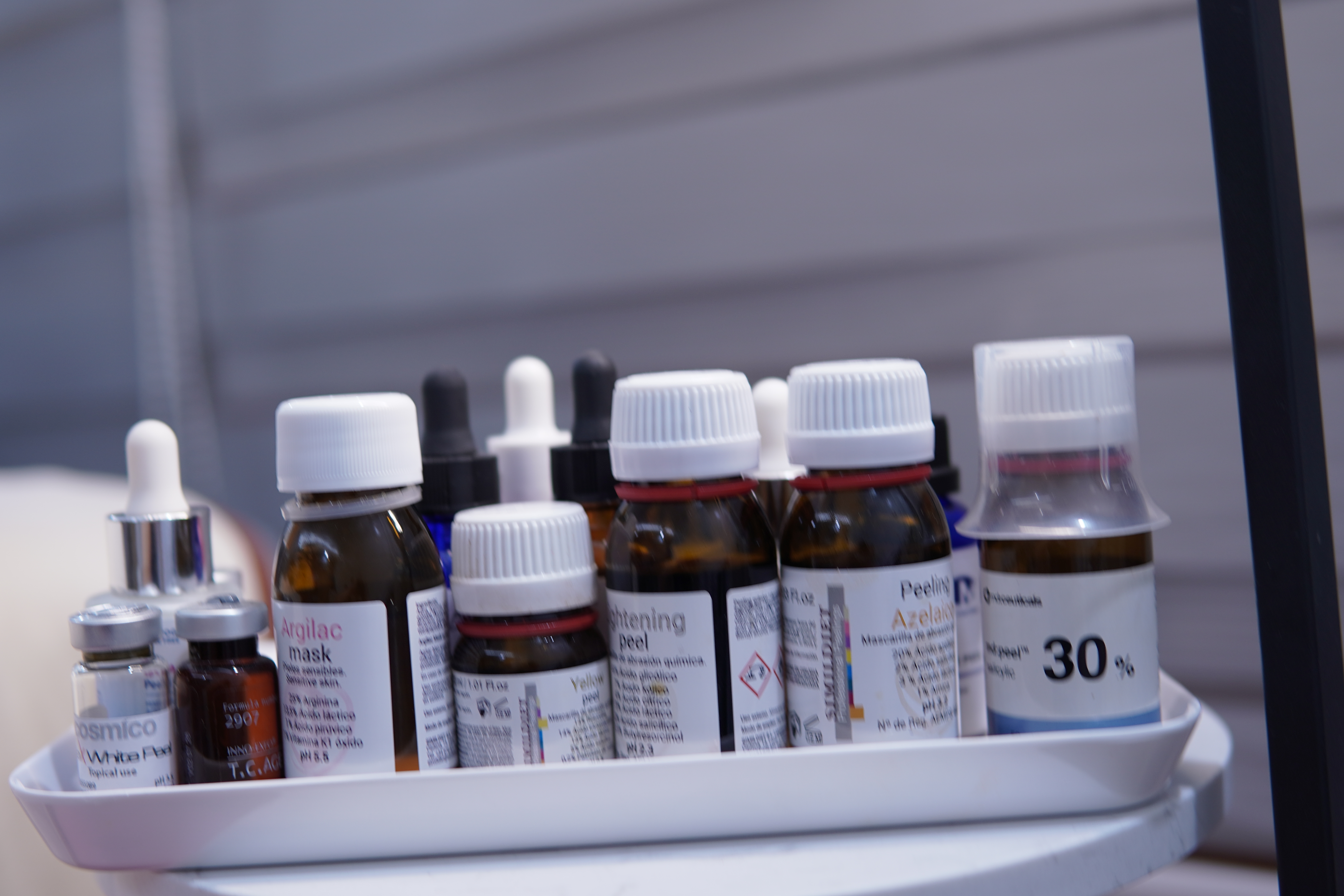
Overview
A chemical peel uses active ingredients to create a controlled effect on the skin. Depending on the acid type, concentration, pH, contact time, and skin foundation, a peel may support congestion, acne, dark marks, dullness, or the skin surface. However, clients often judge a peel by whether there is extensive peeling. This view is incomplete.
How peels work
Peels alter connections between keratin cells and promote renewal at a controlled level. Some peels are intended more for oil and congestion, some are gentler for pigmentation or sensitive skin, and some act more deeply and require longer recovery.
The acid name is only one part. Salicylic, mandelic, glycolic, and TCA can create very different reactions depending on formula, concentration, pH, and use.
Common indications
Peels may be considered for closed comedones, blackheads, oiliness, dull surface texture, post-acne marks, and mild texture concerns. Some gentle peels can be used within a plan for pigmentation control or to support the skin-renewal cycle.
Peels are not only for oily skin. Dry or sensitive skin may still have an indication, but the appropriate type needs to be selected and the skin barrier prioritised.
When should a peel not be performed immediately?
Skin that is burning and red, peeling from retinoids, has open wounds, infection, sunburn, or has just had a strong procedure is commonly not suitable. Clients who are self-using multiple acids, retinol, or exfoliating products need to disclose this fully.
A peel should not be performed only because the skin feels “unclean” or the client wants rapid peeling. If the barrier is weak, a strong peel can create small bumps, prolonged redness, and post-inflammatory hyperpigmentation.
Is peeling the standard for effectiveness?
No. Some effective peels cause very little or almost no visible peeling. The degree of peeling depends on keratin-layer thickness, formula, contact time, and post-treatment care.
Extensive peeling does not mean pigmentation will fade faster. Conversely, trying to create strong peeling can prolong recovery. The objective needs to be changing the skin condition, not creating a dramatic post-treatment image.
Limitations of peels
Peels cannot fill deep pitted scars, replace hormonal management, or address every type of melasma in one session. With severe inflammatory acne, the degree of acne needs assessment and medical direction may be needed rather than continuous peeling alone.
If congestion is caused by cosmetics, makeup, habits, or an unsuitable home routine, a clinic peel addresses the concern only temporarily unless those factors change.
Recovery after a peel
After a peel, skin may sting, become dry, tight, mildly red, or peel finely. Clients need moisturising, sun protection, avoidance of picking, and a pause on strong active ingredients.
If blistering occurs, burning pain increases, redness persists, skin darkens rapidly, or there are signs of infection, the clinic needs to be contacted immediately. Clients should not add acids, mixed creams, or brightening products to “speed up peeling.”
Risks
Risks may include irritation, chemical burns, post-inflammatory hyperpigmentation, acne flare-ups, delayed healing, and infection. Risk increases when clients do not disclose products they are using or when the practitioner uses an unsuitable concentration.
Asian skin needs particular attention to post-inflammatory pigmentation. A sufficient peel repeated at the right rhythm often has more value than one overly strong session.
What can a peel be combined with?
A peel can be part of a plan with cleansing, LED, Pico, mesotherapy, recovery care, and home care. However, it should not be assumed that every session needs many additional methods.
With acne, inflammation may need control first before impact is increased. With pigmentation, sunscreen and home products play a large role. With weakened skin, recovery may be needed before a peel.
DIVA’s Perspective
At DIVA, a peel is selected according to the main concern, skin type, product history, and recovery capacity. Clients do not need to choose an acid or concentration themselves.
A suitable peel session needs a clear objective: reduce congestion, support pigmentation, even the surface, or prepare for the next step. If the objective cannot be identified, a peel should not be performed simply to make the skin peel.
Conclusion
A peel is a flexible tool, but it can be overused because it appears simple. Good results do not lie in the degree of peeling, but in moving the skin closer to its objective with fewer unnecessary reactions and a maintenance plan.
The right peel is one that is sufficient for the current skin foundation, not the strongest peel the skin can tolerate in one session.
A Peel Does Not Always Cause Clearly Visible Peeling
Introduction
Many clients judge a peel by the degree of peeling: the more skin that peels, the more effective they assume it is. This is a common misconception. A peel uses chemical substances to create a controlled effect on the target skin layer. Depending on the acid type, formula, skin foundation, and objective, the reaction may be only mild dryness, temporary darkening, fine flaking, or no visible peeling. Effectiveness lies not only in skin that comes away, but in how keratinisation, congestion, pigmentation, and inflammation are adjusted. For this reason, no clear peeling does not mean that a peel is not working.
Why does the degree of peeling differ?
The degree of peeling depends on treatment depth, active ingredient type, solvent, number of layers, contact time, body area, and recovery capacity. A light surface peel can create cellular change without producing large sheets of peeling skin. Thick, oily skin may react differently from thin, dry skin. With the same formula, a person using retinoids or who has recently had a procedure may peel more strongly. Comparing the degree of peeling between two people therefore does not show who received better treatment.
What benefits can a peel without visible peeling provide?
A light peel can help soften the keratin layer, reduce congestion, improve brightness, support oil control, and create a more even surface. These changes can occur without obvious downtime. For sensitive skin or clients who need to return to work quickly, a low-peeling peel may sometimes be more suitable. In a long-term plan, several controlled light impacts can be safer than one overly strong treatment. DIVA prioritises stable results and recovery capacity; it does not create peeling merely to make clients feel that the service was strong.
Is more peeling better?
More peeling shows that the surface layer has been affected more visibly, but it also comes with water loss, sensitivity, and a greater risk of inflammation. If the skin is not strong enough, a strong reaction can lead to prolonged redness, post-inflammatory hyperpigmentation, or acne flare-ups. A peel that is too deep for the objective does not create corresponding benefit. Particularly for Asian skin and skin prone to dark marks, inflammation control is more important than creating an impressive sign. DIVA does not view strong peeling as a mandatory standard of a successful peel session.
How DIVA selects a peel level
Before a peel, DIVA considers the main concern, skin thickness, barrier, active ingredients in use, previous peel response, and ability to follow aftercare. If the skin is weakened, the objective may be only preparation and recovery rather than a strong peel. If the skin has congestion but little inflammation, a suitable formula may be chosen. With pigmentation, PIH risk needs consideration. The level of impact is adjusted according to the actual response, not a client’s wish to peel heavily.
Expectations after a session
The skin may become smoother, brighter, or less oily after a few days. Some people feel tightness, dryness, or fine flakes; others see almost no surface change but still improve gradually. With acne and pigmentation, assessment needs a longer cycle rather than the first day. A peel cannot erase deep scars or resolve melasma completely on its own. DIVA explains the objective of each session so clients know what to expect and do not increase active ingredients themselves because the skin has not peeled.
Care when peeling is not obvious
Even when the skin does not visibly peel, the barrier may still be more sensitive. Clients should avoid rubbing, exfoliants, retinoids, or other acids until instructed to resume them. Gentle cleansing and suitable moisturising help reduce irritation. The skin should not be forced to peel by adding more products. If burning increases, blistering, spreading redness, discharge, or pain occurs, the clinic needs to be contacted promptly. An unusual reaction should not be dismissed as a skin-shedding process.
When does the plan need reassessment?
If there is no improvement at all after multiple sessions, the objective, formula, or initial assessment may not be appropriate. Conversely, if every peel produces strong peeling and the skin becomes increasingly sensitive, the plan also needs to change. DIVA monitors recovery capacity, not only photos immediately after a session. Good treatment is when the main concern gradually reduces while the skin foundation remains stable. Sometimes it is necessary to switch to laser, RF, injections, or home care rather than keep increasing peel intensity.
Conclusion
A peel does not need obvious peeling to be effective. The appropriate degree of reaction depends on the objective and the skin foundation. DIVA does not create peeling as a performance and does not use a burning sensation as a measure of effectiveness. Clients should focus on changes in acne, pigmentation, surface texture, and stability over time. Starting with one suitable session helps observe the skin’s response before deciding whether to continue or adjust the plan.
Nguyen Hai Dang — Founder & Treatment Practitioner
Why Should Weakened Skin Not Begin with a Strong Peel?
Introduction
When dullness, acne, or dark marks persist, many people want a strong peel to see rapid change. However, if the skin barrier is weakened, strong impact can make the concern more complex. Weakened skin is not only a feeling of thinness; it can appear as redness, burning, prolonged peeling, dehydration, small bumps, or reactions to many products. In this state, the ability to control inflammation and recover is reduced. A strong peel can create additional injury before the skin has enough capacity to repair itself.
What is the role of the skin barrier?
The skin barrier helps retain water, limit irritants, and regulate inflammatory responses. When the barrier is weakened, topical products can penetrate less predictably and burning increases. The same peel may cause a mild reaction in healthy skin but a burn or prolonged inflammation in weakened skin. For this reason, assessing surface health is as important as assessing acne or pigmentation. If a plan looks only at the concern being treated and ignores recovery capacity, it can fail.
What happens when a peel is too strong?
Skin may develop prolonged redness, sheet-like peeling, burning pain, blistering, or discharge. After the acute stage, the risk of post-inflammatory hyperpigmentation, acne flare-ups, and chronic sensitivity increases. Some people have to stop all treatments for a long period, making progress much slower than recovering first. A strong reaction also makes it difficult to identify the cause because the skin may react to subsequent care products as well. DIVA does not consider this a sign that the peel is working well.
Signs that recovery is needed first
Burning during cleansing, unexplained peeling, persistent redness, tight and dry yet oily skin, stinging with moisturiser, or recent use of multiple acids and retinoids are signs requiring caution. A history of peels, laser, or creams with unclear ingredients also matters. If skin has infection, dermatitis, or unusual lesions, suitable medical assessment is needed. DIVA may ask clients to temporarily stop treatment products and move to a minimal routine before considering a peel.
Recovery does not mean no treatment
The recovery stage is part of treatment, not pointless delay. The objective is to reduce baseline inflammation, increase stability, and make skin responses more predictable. Once the skin foundation is better, a gentle peel or another technology can create results with lower risk. Many clients want to see peeling to feel that something has been done, but sometimes the best decision is not to peel yet. DIVA prioritises what the skin needs, not the feeling of a strong service.
How to restart
Once skin is stable, DIVA reassesses the main concern and selects a lower level of impact. A suitable trial session helps observe recovery capacity. If the skin responds well, the plan may increase gradually or combine methods. There is no fixed escalation schedule for everyone. Returning to home treatment is also adjusted according to response. This step-by-step approach avoids the cycle of strong peel, irritation, recovery, then another strong peel.
Realistic expectations
Weakened skin usually cannot both recover and receive strong treatment for acne, pigmentation, and scars in one session. Priorities can change by stage. As redness and burning reduce, clients may see more even skin and fewer small bumps even before the main treatment impact. Long-term results are better when the skin foundation remains stable. DIVA does not promise a fixed time because the degree of injury and home habits differ. Patience in the early stage often shortens the later time needed to correct mistakes.
Client responsibility
Clients need to truthfully disclose products in use, avoid self-adding acids, retinoids, or mixed creams during recovery, and report reactions early. If strong products continue at home while the clinic is trying to restore the skin, results will not be stable. This is not about blaming the client; it identifies the work that needs cooperation. DIVA is responsible for assessment, explanation, and adjustment; the client is responsible for following guidance and providing accurate information.
Conclusion
Weakened skin should not begin with a strong peel because its tolerance and recovery capacity are not sufficient. Stronger treatment at the wrong time can create additional inflammation and pigmentation, prolonging the concern. At DIVA, recovery of the skin foundation is prioritised when needed, then a suitable peel or technology is selected. Clients can begin with one assessment and baseline-care session without buying a long package. The objective is to return the skin to a state that can be treated safely before moving toward more noticeable change.
Nguyen Hai Dang — Founder & Treatment Practitioner
Why Does Downtime After a Peel Differ?
Introduction
Two people can receive the same peel and have completely different downtime. One may have only mild dryness, while another may peel visibly or become temporarily darker. The difference does not necessarily show that one person received stronger or more effective treatment. Downtime results from treatment depth, peel type, skin foundation, treatment area, care, and individual response. Understanding this helps clients avoid comparing their photos with someone else’s or intervening when skin is recovering normally.
Depth of impact
A superficial peel commonly causes redness, tightness, or fine flaking; a deeper peel may cause darkening, crusting, and visible peeling. Depth depends not only on concentration, but also on pH, solvent, number of layers, contact time, and skin preparation. For this reason, acids with the same name but different formulas can create different downtime. DIVA assesses reactions according to the specific product and skin foundation, not by the percentage of active ingredient alone. The objective is appropriate depth, not maximum depth.
Skin foundation and barrier
Dry, sensitive, retinoid-using, or over-treated skin usually reacts more strongly. Thick, oily skin may peel less even when the peel is working. Skin colour and PIH tendency also affect progression after inflammation. A person with a healthy barrier commonly recovers more steadily. Recovery before a peel can therefore make downtime more controllable. If the skin foundation is ignored, the same procedure may be safe for one person but excessive for another.
Treatment area
The face, neck, back, underarms, and legs differ in thickness, friction, and recovery speed. Areas around the mouth and nose may peel more visibly because of movement, while other areas may only be dry. The body commonly recovers more slowly than the face and is more prone to darkening with friction. DIVA adjusts the plan by area and does not use one predicted recovery time for the whole body. Clients need to know which areas may darken or develop crusts so they can prepare appropriate care.
Care after a peel
Picking peeling skin, rubbing while cleansing, hot water, excessive exercise, or returning to acids too early can prolong downtime. Conversely, overly occlusive care or applying many unfamiliar products can create congestion and inflammation. Good care does not make peeling stop immediately, but it helps recovery remain stable and reduces complication risk. DIVA provides guidance according to the actual peel level. Clients should not copy someone else’s routine simply because they received a service with the same name.
Individual response
Age, sleep, environment, medication, habits, and general health affect recovery speed. Some people have little redness but peel later; others become visibly red and then recover quickly. Reactions after a previous session are important data for adjusting the next one. DIVA does not view downtime as a fixed number. If clients need to return to work quickly, the objective and peel level can be changed to fit their routine instead of requiring unnecessary downtime.
Normal and unusual reactions
Dryness, tightness, mild stinging, temporary darkening, and peeling may be expected. Increasing pain, blistering, spreading redness, discharge, an unusual smell, progressive swelling, or fever need assessment. Clients should contact the clinic rather than wait because they assume a peel must hurt. An unusual reaction treated early is usually easier to control. DIVA clearly distinguishes home-monitoring guidance from situations requiring medical assessment or urgent care.
Does downtime relate directly to effectiveness?
No. A low-downtime peel can still be effective for mild congestion or the surface; a high-downtime peel may be needed for a deeper objective but can also be excessive. Effectiveness needs to be assessed by the main concern after skin has recovered, not by the number of peeling days. Trying to prolong downtime to prove that a service is strong is not safe. DIVA prioritises sufficient impact and accumulated results rather than impressive reactions.
Conclusion
Downtime after a peel differs because of many factors, from formula to skin foundation and care. There is no exact recovery schedule that applies to everyone. At DIVA, clients are told the expected progression range and signs that require contact, but the plan is still adjusted according to actual response. Beginning with one suitable session helps understand how the skin recovers before deciding the next treatment level.
Nguyen Hai Dang — Founder & Treatment Practitioner
Is a Stronger Peel Really Better?
Introduction
In aesthetics, the word “strong” easily creates a sense of effectiveness: higher concentration, more peeling, more burning, or longer downtime. However, skin does not improve according to the principle that more injury is always better. A peel needs to create enough impact to begin the desired change while keeping recovery controlled. When impact exceeds tolerance, unwanted injury can be greater than benefit. For this reason, a stronger peel is not automatically better and can sometimes worsen outcomes.
Effectiveness has an optimal range
Every objective has an appropriate range of impact. Mild congestion does not need the same depth as scars or sun damage. As strength increases, benefit may increase to a point while risk continues to rise. Beyond the optimal point, additional injury creates only inflammation, water loss, and pigmentation. This is why practitioners need to assess the endpoint and recovery capacity rather than pursue concentration. DIVA selects the lowest level sufficient to create change for the main objective.
Why do clients easily want a strong peel?
Clients often want to see a clear sign that their money has value. Sheet-like peeling and redness create the impression that a method is working. Social-media images also commonly focus on dramatic reactions. However, these images do not show results after several months, complications, or the skin type of the person treated. DIVA explains in advance that a light session with the right objective can be more valuable than a strong session that forces the skin to stop treatment for a long time.
Risks of an overly strong peel
Burns, blistering, prolonged inflammation, PIH, hypopigmentation, infection, and scarring can occur. Even without severe complications, skin may become sensitive, develop small bumps, and tolerate products poorly. Clients then need to move to recovery and spend time repairing the skin foundation. For Asian skin or skin prone to dark marks, excessive inflammation is especially concerning. A strong peel should not be regarded as a way to shorten a treatment plan.
How DIVA selects the level of impact
Assessment is based on concern type, depth, skin tone, barrier, peel history, medications, and care. If a client has never had a peel or is sensitive, a light trial session helps collect data. If the response is good, the level can be adjusted. There is no fixed escalation pathway. Some cases are suitable for remaining at a light level over many sessions; others should move to another technology rather than continue increasing peel strength. Decisions are based on results, not a feeling that the service must be upgraded.
What can a light peel do?
A light peel can improve the keratin layer, congestion, oiliness, brightness, and support home-care products. Its advantage is lower downtime and easier repetition when needed. For clients with demanding work schedules or skin prone to PIH, this can be a good option. However, a light peel also has limits and should not be promised to resolve deep scars. DIVA clearly explains its role so clients neither expect the wrong outcome nor dismiss the method simply because it does not peel.
When is a deeper method needed?
If the concern lies in structure, such as pitted scars, loss of elasticity, or deep pigmentation, increasing peel strength may not be the optimal direction. CO₂ Fractional, RF Microneedling, Pico, or injectable methods may be more suitable depending on the condition. Good treatment selects the correct layer of impact. Using a strong peel to try to reach a concern it does not address well can create much downtime with little result. DIVA views technologies as tools for different layers, not a simple ranking from light to strong.
How to assess effectiveness correctly
Effectiveness needs to be measured by reduced congestion, a more even tone, improved surface, and maintainability, not the degree of burning or number of peeling days. Before-and-after photos need similar conditions and enough time for the skin to stabilise. If skin improves but recovery takes longer after every session, the plan still needs review. DIVA monitors both results and the biological cost of treatment. A good result should not be exchanged for an increasingly weak skin foundation.
Conclusion
A stronger peel is not always better. The suitable level is one that targets the correct objective and remains within recovery capacity. At DIVA, clients are not encouraged to choose according to concentration or degree of peeling. The plan begins with one suitable session, observes the response, and then adjusts. This may be less impressive on the first day, but it reduces complications and creates a more sustainable process.
Nguyen Hai Dang — Founder & Treatment Practitioner