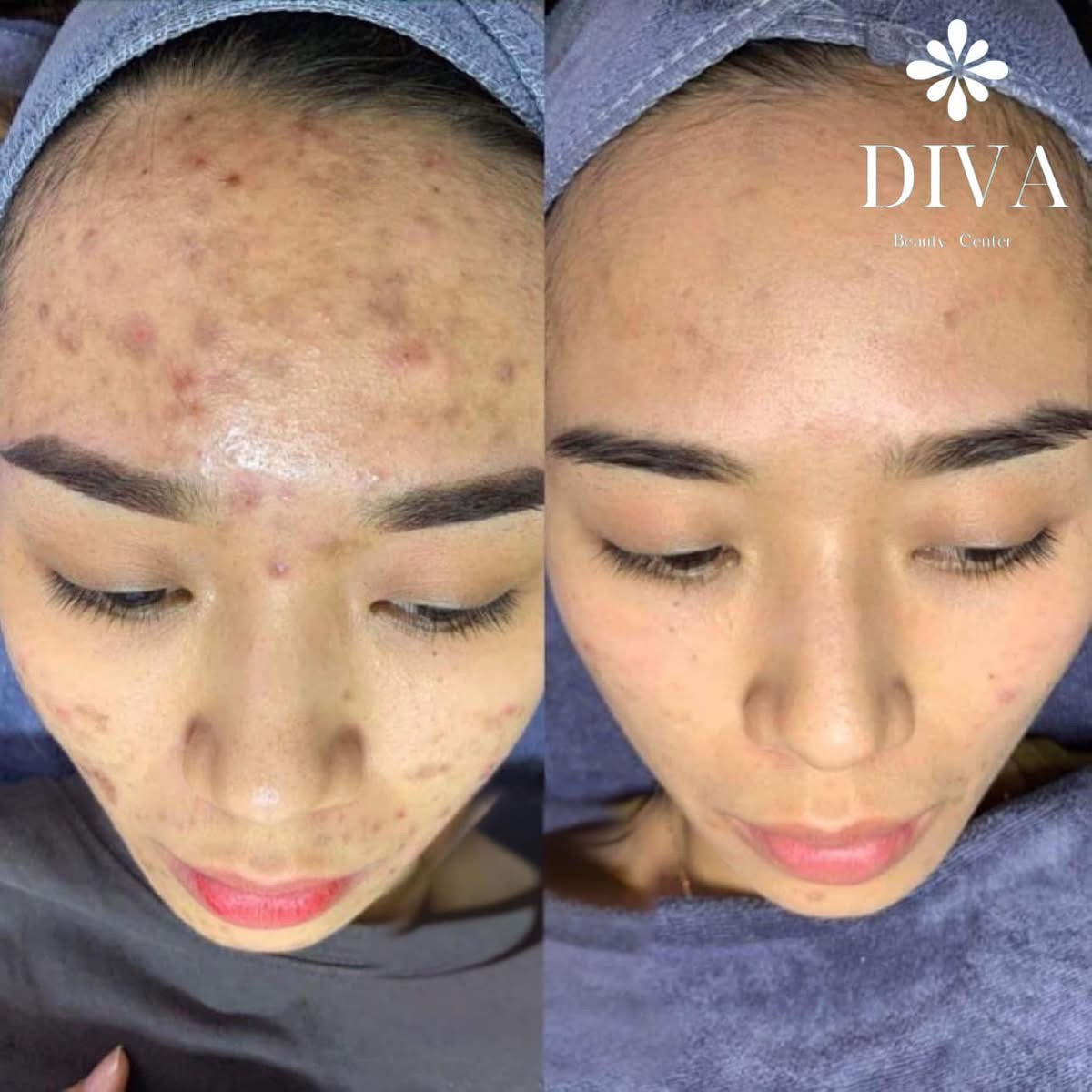
Overview
CO₂ Fractional is one of the most frequently discussed technologies when clients are concerned about pitted scars, enlarged pores, and rough skin texture. It can create more noticeable change than many surface treatments, but it also requires correct assessment, controlled treatment level, and serious recovery care.
How CO₂ Fractional works
CO₂ Fractional creates controlled micro-columns of injury in the skin. Areas of healthy tissue remain between the treated columns to support recovery. The objective is surface regeneration and stimulation of tissue repair, helping texture become smoother and shallow scars improve gradually.
Treatment intensity can vary greatly. A light session intended to support the surface is not the same as deep resurfacing for long-standing scars. For this reason, asking only “How much is CO₂?” is not enough to compare providers.
Common indications
CO₂ Fractional is commonly considered for acne scars, rough skin, visible pores, fine lines, and some uneven surface concerns. Effectiveness depends greatly on scar type.
Rolling, boxcar, or shallow scars may respond differently. Scars tethered to deeper tissue may need subcision first or combination with another method. Deep ice-pick scars also commonly cannot be adequately managed by CO₂ alone.
When should it not be performed yet?
Skin with active inflammatory acne, infection, irritation, a weak barrier, or burning and peeling should not rush into deep CO₂ treatment. People who cannot avoid sunlight, do not have time for recovery, or cannot follow home care also need consideration.
Certain medical histories, current medications, a tendency to abnormal scarring, or recent treatments need to be discussed first. History-taking should not be skipped simply because a client has received CO₂ elsewhere before.
Limitations of CO₂ Fractional
CO₂ does not make scars disappear completely and cannot return the skin to a state in which it never had scars. Results are usually an improvement by degree, accumulated across multiple sessions, and dependent on each person’s capacity for regeneration.
Pores also cannot be permanently “closed.” If oil, congestion, ageing, or dehydration remain, pores may continue to be visible even after the surface improves.
Recovery and common reactions
After CO₂, skin may become red, sting, dry, develop micro-crusts, and peel for several days. Duration depends on the level of impact. This stage needs gentle cleansing, moisturising, sunscreen, and no self-removal of crusts.
Signs such as increasing pain, pus, unusual swelling, persistent redness, or concerning skin-colour change need early assessment. Acids, retinol, or strong whitening creams should not be added by clients when skin is not stable.
Risks that need to be understood
Risks may include post-inflammatory hyperpigmentation, infection, prolonged redness, acne flare-ups, delayed healing, or, more rarely, worsening scars. Risk increases when treatment is too strong, session intervals are unsuitable, or care is incorrect.
Asian skin can be more prone to post-inflammatory hyperpigmentation. For this reason, the idea that “stronger is more effective” should not be followed. Treatment level needs to fit the skin foundation and recovery capacity.
What can CO₂ be combined with?
Depending on scar type, CO₂ can be combined with subcision, PRP/PRF, RF Microneedling, skin booster, or a recovery plan. Each method addresses a different component: tethering, surface, tissue thickness, or skin quality.
Not every method needs to be performed on the same day. A good plan may divide them into separate sessions to control risks and assess response.
DIVA’s Perspective
At DIVA, CO₂ is not selected only because a client has scars. The scar type, depth, current inflammation level, pigmentation risk, and ability to provide post-treatment care need to be identified.
If the skin foundation is not stable, the first session may focus on acne control or recovery rather than deep resurfacing. Once the skin is suitable, CO₂ is used only at the level needed and with a clear objective.
Conclusion
CO₂ Fractional is a strong tool for surface regeneration, but its strength has value only when applied to the right condition at the right time. One deep session does not replace a multi-step plan for complex scars.
Clients should evaluate the method according to indication, practitioner, recovery level, and follow-up plan, not only by the device name or images of red, peeling skin immediately after treatment.
CO₂ Fractional and RF Microneedling Do Not Fully Replace Each Other
Introduction
CO₂ Fractional and RF Microneedling are both used to improve acne scars, pores, and skin texture. Because both aim to stimulate collagen remodelling, many people think they only need to choose the stronger or cheaper technology. In reality, the methods create injury through different mechanisms, affect different layers, and have different downtime profiles. Their uses overlap, but they do not fully replace one another. The choice needs to be based on scar type, skin tone, thickness, inflammation level, and recovery capacity.
How CO₂ Fractional works
CO₂ Fractional uses a 10,600 nm laser to create micro-columns of ablative and thermal injury in the skin. Intervening healthy tissue supports recovery. The method can improve the surface, boxcar scars, shallow scars, fine lines, and sun-related changes. Because it ablates the surface, downtime is usually more visible, with redness, mild oozing, crusting, and peeling depending on the treatment level. PIH risk needs consideration in darker skin or skin prone to dark marks.
How RF Microneedling works
RF Microneedling delivers needles to a selected depth and releases RF energy within the tissue. The surface has small needle points while heat is generated beneath. It can suit scars, pores, texture, and some firmness objectives. Because it causes less surface ablation, downtime can be lower than CO₂ with some settings, but it is not always mild. Needle depth, handpiece type, energy, and number of pulses strongly affect results and risk.
Differences in scar type and layer of impact
Acne scars include ice-pick, boxcar, rolling, and tethered scars. CO₂ has an advantage for the surface and scar edges, while RF Microneedling can deliver heat more deeply with less epidermal injury. However, tethered scars need mechanical release; ice-pick scars may need TCA CROSS; volume-loss scars may need other methods. No technology independently manages every structure. DIVA classifies scars before selecting a device.
Skin tone and pigmentation risk
CO₂ creates more visible surface inflammation, so PIH risk can be higher in darker skin or skin with a history of dark marks. RF Microneedling commonly preserves the surface better but can still cause burns, PIH, or needle marks if used incorrectly. With sensitive or inflamed skin, neither may be suitable yet. DIVA considers recovery capacity and may prepare the skin foundation first. Lower downtime does not mean no risk.
When can they be combined?
The two methods can be used in different sessions or within a combination plan when both surface and deeper layers need to be addressed. However, combination does not mean doing everything on the same day. Accumulated inflammation can increase downtime and PIH. DIVA identifies the main objective of each session: scar release, structural impact, surface improvement, or recovery support. The next step is selected only after observing the response, which controls risk better than an overloaded session.
Expected results
Scars are structural changes and commonly require multiple sessions with accumulated results. The surface may become smoother, scar edges softer, and pores less visible, but complete removal cannot be promised. Results depend on scar type, age, collagen-production capacity, care, and technique. DIVA does not use images taken immediately after treatment, while skin is swollen, as proof that scars have filled. Assessment needs to occur once reactions are stable.
Downtime and care
CO₂ can require care for micro-injuries and avoiding crust-picking; RF Microneedling commonly causes redness, swelling, and needle points. Both require cleansing, recovery care, and avoidance of strong active ingredients as directed. Increasing pain, pus, fever, blistering, or progressive darkening need contact. Clients need suitable recovery time. DIVA explains expected downtime but does not give an absolute number of days because treatment level and skin foundation differ.
Conclusion
CO₂ Fractional and RF Microneedling have different strengths. CO₂ is strong for surface treatment and ablative-column regeneration; RF Microneedling delivers deeper heat through needles and may be more suitable for some skin foundations. They can complement but do not fully replace one another. At DIVA, the choice is based on scar type and the objective of the session, not the technology name. Clients can begin with one suitable session, then build the plan and apply cost credit according to policy if needed.
Nguyen Hai Dang — Founder & Treatment Practitioner